
The model Context Protocol - AI Tools On Demand
This has gone under the radar but might be as important as Deepseek is for open source, as soon as you use it with agents you know why I am saying this.

Introduction
In today's rapidly evolving AI landscape, effective communication between humans and AI models has become increasingly vital. As businesses and developers strive to harness the power of artificial intelligence, there's a pressing need for standardized methods to interact with these sophisticated systems. Enter the Model Context Protocol - a groundbreaking approach to structuring and managing AI model interactions.
The Model Context Protocol functions as a universal translator between human intentions and AI comprehension. Just as HTTP revolutionized web browser and server communication, this protocol establishes a common language for AI model interactions. For business owners and technical teams, this translates to more reliable, efficient, and consistent results when working with AI systems.
The protocol's significance extends far beyond its technical implementation. It represents a fundamental shift in how we approach AI integration within business processes. Whether you're developing customer service chatbots, implementing automated content generation, or building complex decision-support systems, mastering the Model Context Protocol can be the critical difference between mediocre and exceptional AI implementations.
Let's explore the world of Model Context Protocol and discover how it can transform your AI development journey.
Technical Overview
The Model Context Protocol (MCP) represents a significant advancement in how we structure and manage interactions between AI models and their accessible tools. At its core, the protocol establishes a standardized framework for defining and controlling the operational context of AI models, ensuring both flexibility and security in their interactions with external resources:
MCP Hosts: These are applications (like Claude Desktop or AI-driven IDEs) needing access to external data or tools
MCP Clients: They maintain dedicated, one-to-one connections with MCP servers
MCP Servers: Lightweight servers exposing specific functionalities via MCP, connecting to local or remote data sources
Local Data Sources: Files, databases, or services securely accessed by MCP servers
Remote Services: External internet-based APIs or services accessed by MCP servers
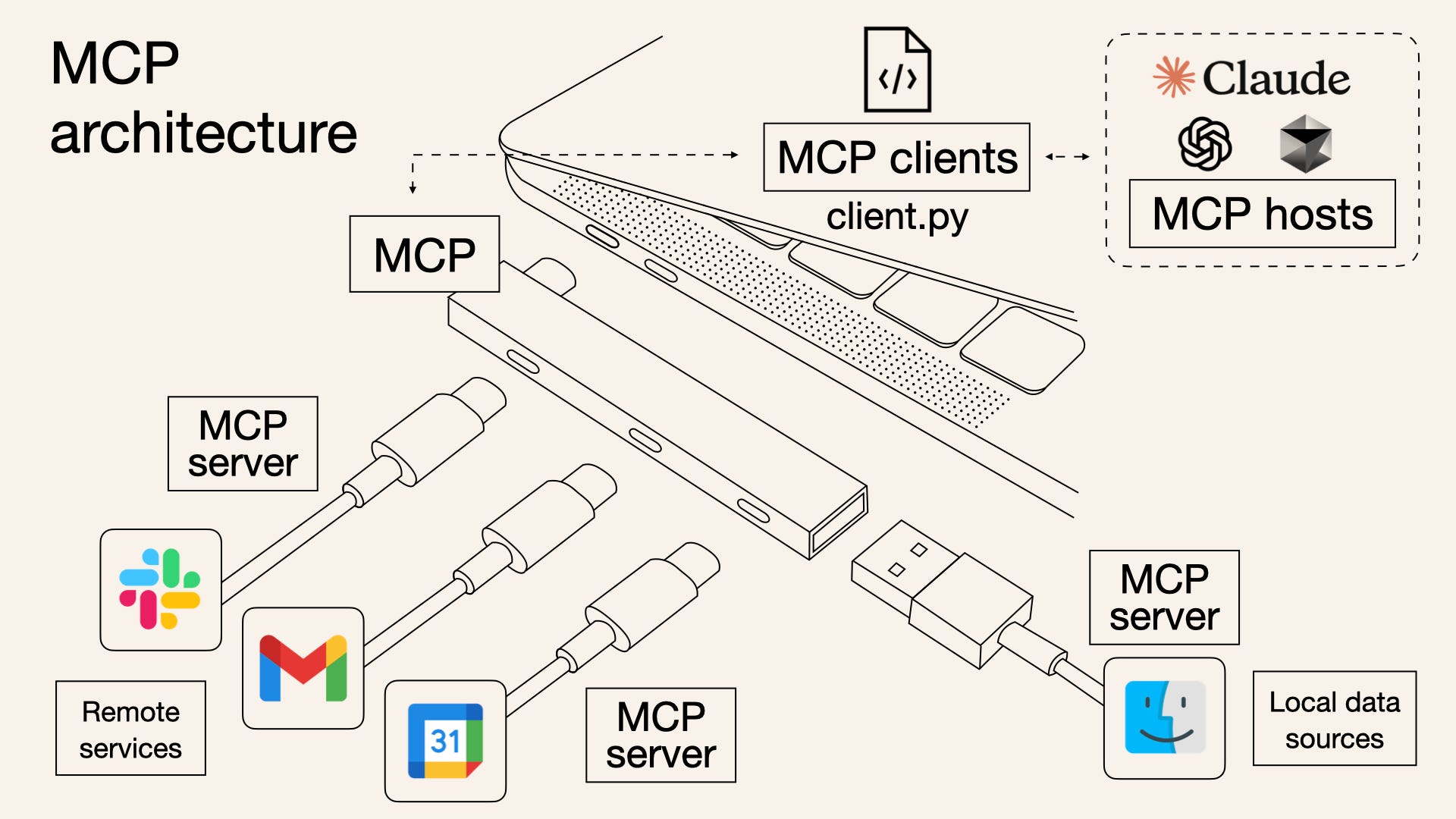
Three primary components
The Model Context Protocol (MCP) architecture consists of four essential components designed to integrate large language models effectively (LLMs) with external resources and contexts:
Host
Hosts represent applications utilizing LLMs. They manage interactions, orchestrate communication, and control lifecycle events. The primary responsibilities of a host include:
Lifecycle Management: Initializing and maintaining connections.
Capability Negotiation: Communicating and aligning protocol versions and capabilities with clients and servers.
Message Coordination: Managing the overall flow of requests and responses.
Example hosts include applications such as File explorers, Git interfaces, or specialized LLM-based IDE plugins.
Client
Each client manages a dedicated connection with a single server and is responsible for:
Dedicated Connection Management: Ensuring secure and isolated communication.
Message Routing: Facilitating efficient two-way communication (requests, responses, notifications) between host and server.
Capability Negotiation: Agreeing on capabilities and protocol compatibility during the initial handshake.
Subscription Management: Handling subscriptions and notifications related to server resource updates.
Server
Servers provide external data, context, and capabilities to LLMs. They consist of three primary elements:
Tools: Executable functions or API integrations (e.g., APIs for Gmail, Slack, Notion) that enable LLMs to perform specific tasks.
Resources: Contextual information such as text files, log files, database schemas, file contents, or Git histories.
Prompt Templates: Predefined text structures guiding how the LLM interacts and processes information.
Base Protocol
The Base Protocol standardizes communication between hosts, clients, and servers. It defines:
How messages (requests, responses, notifications) are structured and transmitted.
Lifecycle management, including connection initialization, negotiation of capabilities, and ongoing communication protocols.
Together, these four components form the robust, secure, and dynamic foundation of MCP, enabling seamless integration of AI models with real-world contexts and resources.
Implementation and Integration
Implementing the Model Context Protocol in your AI applications demands meticulous attention to both technical requirements and best practices. Let's examine the essential steps and considerations for achieving successful implementation and integration.
Setting Up the Protocol Environment
The initial phase in implementing the Model Context Protocol involves configuring your development environment. You must verify that your system fulfills the protocol's technical requirements, including robust support for the standardized JSON message format and secure transmission channels [1]. Fortunately, most contemporary development frameworks and programming languages offer native support for these requirements, which simplifies the initial setup process.
Key Implementation Steps:
1. Message Structure Implementation
Start by implementing the foundational message structure that conforms to the protocol specifications:
```python

# Example Model Context Protocol message structure

```python

def create_context_message(model_id, parameters, metadata):

    return {

        "protocol_version": "1.0",

        "model_context": {

            "model_id": model_id,

            "parameters": parameters,

            "metadata": metadata

        },

        "timestamp": datetime.utcnow().isoformat()

    }

```
Communication Method
Decide how your application will communicate:
Local (stdio): Ideal for quick local testing and small-scale integrations.
Example:
import sys

message = create_message("update", {"status": "ok"})
sys.stdout.write(json.dumps(message))
HTTP API: Recommended for web-based or remote integrations.
Example:
import requests

url = 'https://api.example.com/update'
message = create_message("update", {"status": "ok"})
response = requests.post(url, json=message)
Connect and Communicate
Establish a clear connection between your client and server.
Clearly define how they will exchange messages and handle responses.
Security and Monitoring
Implement basic security practices (validate inputs, sanitize data).
Keep detailed logs of communications for monitoring and debugging.
Simple Example (Logging):
import logging
logging.basicConfig(filename='app.log', level=logging.INFO)

message = create_message("login", {"user": "alice"})
logging.info(f"Message sent: {message}")
References:
[1] Model Context Protocol Official Specification - Technical requirements and message format standards
[2] Digital Ocean Technical Resources - Best practices for protocol integration in distributed systems
Business Benefits - Building Agents Fast
The Model Context Protocol delivers substantial business benefits that directly enhance an organization's bottom line and operational efficiency. Let's explore the key advantages that make this protocol an invaluable investment for forward-thinking companies.
First and foremost, implementing the Model Context Protocol significantly reduces development time and costs. Industry studies demonstrate that organizations using standardized AI protocols achieve up to 40% faster development cycles compared to those relying on custom solutions. This acceleration in development directly translates to quicker time-to-market and lower resource expenditure.
Integration flexibility stands out as another crucial benefit. The protocol's standardized approach enables businesses to seamlessly transition between different AI tools and providers without requiring extensive recoding or system overhauls. This vendor independence safeguards investments and provides strategic leverage during service provider negotiations.
# Report Writer Agent
report_writer = Agent (
name="writer"
instruction="'™"You are a technical report writer specializing in research
documents. Your role is to:
1. Create well-structured, professional reports
2. Include proper citations and references
3. Balance technical depth with clarity

Save your report to the filesystem with appropriate formatting.
BE 1810

server_names=["filesystem", "fetch"],
AI Engineer made a good video about this technically
Future Implications
The Future Implications of the Model Context Protocol
As we look ahead, the Model Context Protocol (MCP) is poised to fundamentally transform how we develop and deploy AI systems. This evolution presents both promising opportunities and critical considerations that organizations must prepare for.
One of the most significant implications is the standardization of AI model interactions across diverse platforms and providers. This standardization is expected to foster a more dynamic ecosystem where AI services and tools can seamlessly integrate and collaborate. You find a tool today that can do analysis on the complete stock market, then within the hour you could have it integrated in your agent.
Looking forward, for business leaders and technical teams, preparing for this future necessitates investing in MCP-compatible infrastructure, providing comprehensive protocol implementation training, and developing sophisticated strategies for context management and governance.
Conclusion
The Model Context Protocol marks a pivotal advancement in creating more reliable, controllable, and effective AI interactions. As organizations increasingly integrate AI systems into their operations, a standardized framework for managing context and controlling model behavior becomes essential.
The implementation of the Model Context Protocol offers organizations several significant advantages:
First, it establishes a structured approach to context management, ensuring AI models receive consistent, well-formatted information that precisely guides their responses. This standardization results in more predictable and reliable AI interactions, minimizing the risk of misinterpretations or inappropriate outputs.
Second, the protocol strengthens security and compliance by providing organizations with enhanced control over how their AI models process and respond to information. This feature proves particularly valuable in regulated industries and when handling sensitive data, where maintaining strict oversight of AI behavior is paramount.
Looking ahead, the Model Context Protocol will likely evolve in parallel with advancing AI technologies, potentially becoming a fundamental component of organizational AI system management. For businesses planning to implement AI solutions, adopting the Model Context Protocol represents a strategic investment in building a robust and future-ready AI infrastructure.
Sources and Further Reading
1. Resource from anthropic.com - https://www.anthropic.com/news/model-context-protocol
2. Resource from modelcontextprotocol.io - https://modelcontextprotocol.io/docs/concepts/architecture
3. Resource from spec.modelcontextprotocol.io - https://spec.modelcontextprotocol.io/specification/2024-11-05/
4. Resource from techcommunity.microsoft.com - https://techcommunity.microsoft.com/blog/azure-ai-services-blog/model-context-protocol-mcp-integrating-azure-openai-for-enhanced-tool-integratio/4393788
5. Resource from ai100.stanford.edu - https://ai100.stanford.edu/gathering-strength-gathering-storms-one-hundred-year-study-artificial-intelligence-ai100-2021-1/sq2
6. Resource from workos.com - https://workos.com/blog/model-context-protocol
7. Resource from towardsai.net - https://towardsai.net/p/data-science/what-is-mcp-by-anthropicmodel-context-protocol
8. Resource from modelcontextprotocol.io - https://modelcontextprotocol.io/introduction
9. Resource from dev.to - https://dev.to/mehmetakar/model-context-protocol-mcp-tutorial-3nda
10. Resource from portkey.ai - https://portkey.ai/blog/model-context-protocol-for-llm-appls
11. Resource from github.com - https://github.com/modelcontextprotocol
12. Resource from thecloudgirl.dev - https://www.thecloudgirl.dev/blog/what-is-mcp
13. Resource from norahsakal.com - https://norahsakal.com/blog/mcp-vs-api-model-context-protocol-explained/
14. Resource from willowtreeapps.com - https://www.willowtreeapps.com/craft/is-anthropic-model-context-protocol-right-for-you
15. Resource from learnprompting.org - https://learnprompting.org/blog/what-is-model-context-protocol